What Makes Hammersmith So Special?

After nearly 14 years as a member of Hammersmith Chess Club, I believe the answer is clear.

What makes this club special is not just the chess. It is the spirit of the place.

It is the sense of ownership that members feel: this is their club. It is the camaraderie — the way Hammers support one another, compete together, and take pride in each other’s successes. It is the welcome we offer, creating a safe and friendly environment where people come not only to play chess, but also to make friends.

Our club reflects London, and especially Hammersmith and Fulham, at its best: diverse, open, and outward-looking. We build friendships beyond our own walls, and even beyond our own city. Our recent trip to Lübeck was a perfect example of that spirit in action.

We are also ambitious in what we offer. We actively support women’s chess, girls’ chess, juniors, beginners and improvers. We innovate. We bring in outstanding guest lecturers. And we are fortunate to have a superb venue in which all of this can happen.

All of these things are part of our DNA. They define who we are.

But none of them happens by accident.

At the heart of Hammersmith Chess Club is one thing above all else: our volunteers.  The trainers, captains, committee members and helpers who give their time, energy and expertise so generously.

People such as Adam, Ana, Jenny, Sarah, Gaston, David, David, Christof, Nadim, Tom, Tom, Richard, and many others contribute enormously to the life of the club. They step forward, take responsibility, and make things happen. They do so not for reward, but because they believe in the club and want to see it flourish.

That, more than anything else, is what makes Hammersmith Chess Club so special.

Now that we are a charity, our ambition is greater than ever. We want to do more, and to do that, we need more volunteers.

So if you can help, please get in touch at jdrw9591@gmail.com.

You could become a captain, help with one of our classes or club sessions, support an event, or simply bring fresh ideas. However you choose to contribute, you will be helping the club continue to grow and evolve.

Our immediate need is for the Community Event in Ravenscourt Park on 18 July 2026, where Hammersmith Chess Club will have a stand. If you can help, please check the WhatsApp poll and put your name forward.

Many hands really do make light work.  More importantly, they help build the kind of club we all want to belong to.

So this is a call for Hammers to assemble.

Join the team.

John White
Events Officer

Reminder: General Meeting 7.30pm Monday 13th July MSC

All members are warmly invited to attend.  The General Meeting will be followed by a blitz tournament including our guests from Lübeck!

The committee for the coming year is:

  • Adam Cranston – Chair
  • Christof Brixel – Treasurer
  • Dave Lambert – Secretary
  • Gaston Franco – Club Captain
  • Sarah Ewart – Membership Secretary
  • David Steyn – Webmaster
  • Richard Thursby – Deputy Webmaster
  • Tom Townsend – Junior Officer
  • Jenny Mulholland – Beginners Officer
  • John White – Events Officer
  • Anastasija Royce – Diversity Officer
  • Tom Rendle – Advisor

We are particularly delighted to welcome Jenny, Sarah and Richard who have all recently joined the committee. Fresh ideas and new volunteers are vital to the success of the club, and we are extremely grateful that they have stepped forward to help.

Hammersmith Chess Club has always depended on the generosity of its members. Every coaching session, junior activity, league match, social event, website update and administrative task happens because volunteers give their time and expertise. As the club continues to grow—and now that we are a registered charity—that support is more important than ever.

Whether you can spare a few hours each month or are willing to take on a larger role, your contribution can make a real difference.  We would love to hear from you.

From The London League To The Hanseatic League


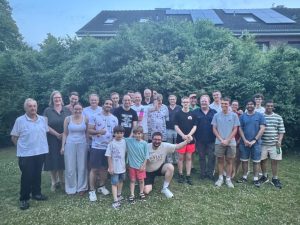
Twenty-two members of Hammersmith Chess Club travelled to Lübeck last weekend to renew a friendship that began seven years ago when a group from Lübeck Chess Club visited Hammersmith during our summer season at the Albion. We always intended to return the visit, but the pandemic intervened. This year, we finally made the journey.

Lübeck Chess Club proved a wonderful host. Founded more than 150 years ago, it has over 200 members, thriving junior sections, around 20 teams and its own dedicated clubhouse—making it a club with much in common with Hammersmith.

Our travelling party reflected the breadth of our own club: juniors and adults, competitive players and social members, parents and supporters alike.

The weekend began with a Friday evening blitz tournament, won by Tony Niccoli ahead of Peter Finn, followed by a rapid tournament on Saturday, won by one of Lübeck’s talented junior FMs. Temperatures climbed above 37°C, making the playing hall almost as challenging as the opposition! The planned long-play match was sensibly abandoned because of the heat, but an excellent barbecue hosted by our Lübeck friends ensured the afternoon was no less enjoyable.

Sunday was devoted to exploring Lübeck itself—a beautiful Hanseatic city and well worth a visit. As always, however, the lasting memories were not only of the chess but of the friendships renewed and new ones made.

The exchange continues this weekend when our Lübeck friends visit London. They’ll be joining us for a friendly match on Friday evening, attending ChessFest on Sunday, and taking part in our club blitz tournament on Monday 13 July.

Notice of General Meeting

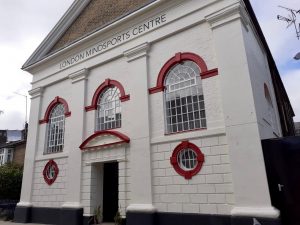
Members are hereby given notice that a General Meeting of Hammersmith Chess Club will take place at the Mindsports Centre on Monday 13 July 2026 at 7.30pm.

A important milestone in our history, this will be the first General Meeting of Hammersmith Chess Club as a registered charity.

It marks the next stage in our evolution: strengthening our foundations, widening our community role, and continuing to build a club that is about more than the game itself.  Now with charitable status, we have the opportunity and responsibility to carry that vision further.

The agenda will be:

1. Annual report of the Club, including our finances up to 19th April 2026;

2. Outlook for the next year, our first full year as a charity.

All members are warmly encouraged to attend and take part in shaping our next chapter.

Hammers In The Community: 18th July


Hammersmith Chess Club will be taking part in a community event in Ravenscourt Park on Saturday 18 July, where we’ll be flying the flag for the club and showcasing the joys of over-the-board chess to the wider public.
It’s a great opportunity to promote the club, meet local people, and perhaps inspire a few future Hammers.

To make the day a success, we’d love as much support as possible:
● Meet at the Mindsports Centre at 10.00am
● Transport and set up equipment in the park from 11.00am
● The event opens to the public at 12 noon

How you can help:
● Gazebo – if you can lend one for the day, please get in touch.
● Transport & set-up – help moving and assembling the kit in the park.
● Play & engage – take on members of the public and help run the stand.
● Blindfold players wanted – if you can play without sight of the board, we’d love to show off your skills!

A car may not be needed, but extra hands definitely will be.  If you can help in any capacity, please email John White at jdrw9591@gmail.com as soon as possible.

Let’s make this a strong Hammers presence in the community.

john White, Events Officer

The Gambit Experiment

In the first of a new series, we invite Christof Brixel to discuss how he reinvented himself and his chess:

There is only one generation between me and the romantic era of chess.  I learned the game from my grandmother when she was 88 years old. She had been born in 1878, around the time of the Steinitz–Chigorin World Championship matches, where the Evans Gambit regularly appeared on the board. Perhaps the King’s Gambit entered my bloodstream there and then.

If so, it disappeared quickly enough. As a junior I moved on to more positional openings, and after returning to competitive chess in London as a senior player, I eventually settled — like many London players — into the reassuring comfort of the London System.

But at the start of the 2025–26 season, I decided to try something entirely different.

I would spend a full season playing gambits.

Not occasionally. Not as a surprise weapon. As a philosophy.

I knew perfectly well what the engines thought of this idea. Many of the positions I intended to play were objectively slightly worse. But amateur chess is not played by engines. It is played by humans sitting at a board with limited time, imperfect calculation and fluctuating nerves.

And besides, I wanted to enjoy myself.

For White, I rebuilt my repertoire around the King’s Gambit and the Smith-Morra Gambit. Against 1.d4 as Black, I added the Albin Countergambit. I studied Daniel King’s material on the King’s Gambit, worked through Chessable courses by Ian Nepomniachtchi, analysed lines myself and spent weeks sharpening my tactical vision with daily puzzle training.

Most importantly, though, I prepared mentally.

For decades I had considered myself primarily a positional player. Suddenly I would be entering complications from move three. I would be sacrificing pawns voluntarily. I would be playing positions where initiative and intuition mattered more than structural soundness.

And I was prepared to suffer for it.

The first surprise of the season was how uncomfortable many opponents became almost immediately. Even strong players often spent huge amounts of time in the opening trying to navigate unfamiliar positions. Again and again, I found opponents burning half their clock in the first ten moves while I played quickly and confidently from preparation.

In one early Central London League game, playing the Albin Countergambit against a fellow Hammer representing Pimlico, I found myself a pawn down but with active pieces and attacking chances everywhere. Replay the game on Lichess  Those positions may not satisfy an engine, but they are tremendous fun to play.

The experiment became particularly interesting during a tournament in Bavaria. After three rounds I unexpectedly found myself on 3/3 in a field packed with titled players — the only untitled player near the top boards. Hammersmith appeared beside my name on the live standings, which pleased me greatly.

More importantly, the gambits were working.

The King’s Gambit in particular produced remarkably practical results. Even experienced players seemed uncomfortable facing it over the board. Sometimes they knew the theory perfectly well but still struggled once the game moved beyond memorisation. Again and again I discovered that understanding the resulting positions mattered more than remembering exact moves.

Not every lesson was positive.

More than once I achieved excellent positions, only to continue playing “street fighting chess” when the position actually demanded simplification and restraint. Switching mentally from attack to technique proved surprisingly difficult.

I also discovered that blitz is not especially useful for learning tactical openings. Blitz games reveal what opponents are likely to play, but they often descend into chaos before deeper positional questions emerge. Rapid and classical games taught me far more about the strengths and weaknesses of the gambits.

There were painful defeats too. In one game I spent two and a half hours enjoying a beautiful attacking position before collapsing completely in the final fifteen minutes. Another time I faced the famous Fischer treatment against the King’s Gambit and found myself in a 73-move battle full of mutual blunders and changing fortunes.

But even those games were strangely enjoyable.

That, perhaps, was the greatest surprise of the season.

At the end of it all, my ECF rating had fallen slightly, but my FIDE rating had risen significantly — particularly in longer time controls, where the additional thinking time seemed to help my tactical approach. More importantly, I felt that my overall chess had improved. The tactical training required for gambit play sharpened areas of my game far beyond the openings themselves.

And there was another unexpected benefit.

At an age when many players simplify their chess and narrow their ambitions, I had deliberately thrown myself into complications, uncertainty and risk. Far from being exhausting, it felt rejuvenating. Gambiteering, I discovered, may be the chess equivalent of anti-ageing therapy.

Will I continue next season? Almost certainly — though perhaps with new openings and new experiments.

But one thing is clear. The spirit of the romantic era still has something to teach us.

And sometimes, the best way to improve at chess is simply to make the game enjoyable again.


Hammersmith Chess Club Becomes A Registered Charity

We’re delighted to share some important news: Hammersmith Chess Club has been formally registered as a charity by the Charity Commission for England and Wales.

This marks an important step in the club’s development. Over recent years, Hammersmith has grown not just in numbers, but in ambition—expanding our junior programme, launching initiatives such as our Women & Girls Hour, and strengthening our role as a welcoming, inclusive space for players of all ages and abilities.

Becoming a charity reflects what the club has already become in practice: a community organisation with a clear purpose. It will help us to build more sustainably for the future, support our outreach work, and ensure that we can continue to make chess accessible to as many people as possible.

This is not a finish line, but a foundation. The focus now is on making the most of this new status—developing our programmes, deepening our links with the local community, and continuing to offer a friendly, competitive and inclusive environment for everyone who walks through the door.

Thank you to everyone who has contributed to the club’s journey so far. We’re looking forward to what comes next.

Adam Cranston
Chairman

Central London League: “1, 2, 3 in 1, 2, 3”

At the start of the season, we set ourselves a clear set of goals in the Central London League.

With three teams entered—Hammersmith 1 and 2 in Division Two, and Hammersmith 3 in Division Four—the brief was simple:

  • Promotion for Teams 1 and 3 to Divisions One and Three
  • Consolidation for Team 2 in Division Two

As it turns out, things went rather well.

Both Hammersmith 1 (captained by Tom Townsend) and Hammersmith 3 (captained by David Steyn) didn’t just compete—they won their divisions convincingly, securing promotion with room to spare. That alone would have made for a very satisfying campaign.

Meanwhile, Hammersmith 2, under the guidance of Andrew Cuff, had a more dramatic journey. After a distinctly shaky start, the team found its footing, steadied the ship, and ultimately did exactly what was asked of it, retaining its place in Division Two.

The outcome is perfect: next season, Hammersmith 1, 2 and 3 will line up in Divisions One, Two and Three respectively.

Job done in the  Central London League, the focus now shifts to the other leagues where there is work to be done and plenty of chess to be played before the season fully wraps up.

Welcome to the Chess Academy!


A New Junior Chess Academy Launches at the Mindsports Centre

We are delighted to announce that a new Junior Chess Academy will be launching at the Mindsports Centre this summer term, run by Adam Cranston.

This is a very exciting development for junior chess in West London. The Academy will focus on competitive play and structured improvement, giving young players the opportunity to receive regular coaching and, just as importantly, to play serious rated games every week in a supervised environment with post-game analysis.

This combination — coaching, competitive games, and analysis — is widely recognised as one of the most effective ways for young players to improve, and we expect the Academy to become an important part of the junior chess scene at the Mindsports Centre.

How it works

Each week, students will receive:

  • 30 minutes of coaching in small groups of roughly equal ability
  • 60 minutes of rated rapid games followed by analysis

Details

  • Time: Wednesdays, 4:30–6:00pm
  • Venue: Mindsports Centre
  • Dates: 15 April to 8 July (excluding 27 May) — 12 weeks total
  • Ages: 6–16, all abilities welcome
  • Cost: £250

Places are limited and the Academy is expected to fill quickly. If interested, please contact Adam directly at adamrcranston@gmail.com.

The Junior Chess Academy is independently run and is not part of Hammersmith Chess Club’s junior programme.  As we continue to develop the chess ecosystem at the Mindsports Centre, we are delighted to welcome the Academy as a partner. Junior chess has never been better served in West London.

A Call to Arms from John White

The Lübeck Heist is back, and this is your final call.

From 26–28 June, Hammersmith heads to Germany for one of our legendary summer raids: blitz, the Beck–Hamm Trophy match, great company, and a proper Hammer weekend.

We’re aiming for a big turnout, adults + juniors.

⏳ Deadline: 31 March

If you’re interested—even vaguely—contact John White now. He’s organising this trip and wants to hear from you.

📩 jdrw9591@gmail.com

The challenge is set.

Hammer needs you.